
Is the hardness of the steel ball you selected suitable?
Nov 19,2020
A customer recently asked why the surface hardness of steel balls, initially 60HRC, increased to 65-67HRC after some time in a mill.
This phenomenon is common; for example, shot-peened parts exhibit significantly higher surface hardness than untreated ones. Similarly, repeatedly bending a wire in the same spot causes heating and hardening until it eventually breaks. This can be explained by work hardening in metals. What is work hardening?
Metal materials undergo changes in internal structure and properties after pressure processing (such as rolling, forging, extrusion, drawing, and stamping), in addition to changes in shape and size. For instance, cold plastic deformation significantly increases the strength and hardness of metals while reducing ductility and toughness—a phenomenon known as work hardening or strain hardening. However, improper pressure processing, exceeding the metal's plasticity, can cause cracks or breakage, explaining why the repeatedly bent wire breaks.
Mining steel balls face a similar issue. Their movement within the mill (dropping, sliding, rolling) involves constant collisions with other balls, ore, and liners, causing work hardening and increased surface hardness. Typically, this increase is 10-15%, explaining the customer's concern.
With advancements in ore processing, mills are becoming larger; the largest semi-autogenous mills reach 13m. This significantly challenges steel balls, increasing the drop height and impact force on ore, balls, and liners. If the balls lack sufficient toughness, they may break under this stress, disrupting mining operations. Therefore, Steel balls require excellent toughness and wear resistance.
Hardness and toughness are inversely related: higher hardness means lower toughness, and vice versa. Excessive hardness reduces toughness, resulting in low impact toughness, insufficient fatigue life, early spalling, and potentially breakage during milling, reducing efficiency and increasing costs. Therefore, what is the ideal hardness for steel balls?
In 1995, Ding Qingru's article "Calculation Method for Grinding Ball Material Selection" noted that ball wear and wear resistance relate to the Hm/Hs ratio (Hm: ball hardness, Hs: abrasive hardness): For low impact, higher hardness materials (Hm/Hs = 1.3-1.7, Hm = (1.3-1.7)Hs) are suitable; for high impact, lower hardness materials (Hm/Hs = 0.7-1.1, Hm = (0.7-1.1)Hs) are preferred.
This steel ball hardness selection method is for reference, but should consider specific mine conditions and requirements. For example, if the ball mill primarily grinds ore to a specific fineness for selection, and the drop height is not significant, prioritize hardness for wear resistance, with sufficient toughness. Large semi-autogenous mills should prioritize toughness to prevent breakage.
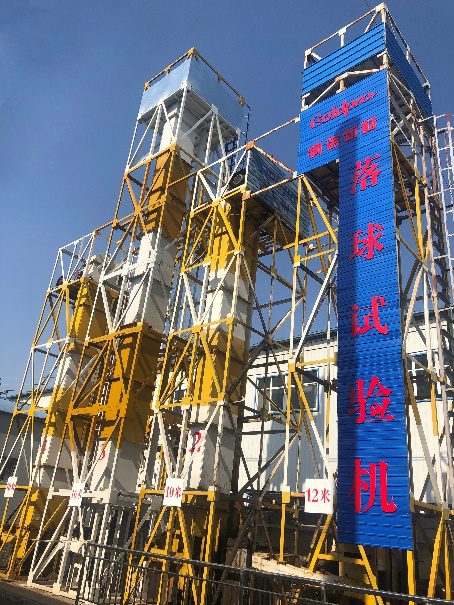
Gangnuo New Materials Co., Ltd. specializes in wear-resistant materials, including mining steel balls, and collaborates extensively with universities. We can tailor products to specific mine conditions, and operate the world's largest 16-meter high drop ball tester (14-meter effective drop), exceeding actual mine conditions for toughness and fatigue life testing. Our expert team, led by academicians, provides solutions for mining challenges, with on-site technical support and 24/7 service.
Gangnuo New Materials Co., Ltd. welcomes your calls, letters, and visits!