
Mineralization characteristics, metallogenic conditions, and prospecting significance of three main types of gold deposits
Nov 05,2020
Abstract: Orogenic, epithermal, and Carlin-type gold deposits can form large-scale regional metallogenic belts or provinces, representing major gold resources and primary exploration targets. This paper systematically analyzes the metallogenic characteristics, conditions, and controlling factors of these three types of gold deposits. It explores the application of these characteristic features and factors in mineral exploration to identify and confirm gold deposit types, and to conduct targeted exploration based on different metallogenic characteristics and controlling factors, providing reliable theoretical and methodological guidance to improve gold exploration efficiency.
Previous studies have shown that gold deposits can develop in all geological periods, various geological processes, and rock types, forming a wide variety of deposit types. Therefore, the classification of gold deposits has been a subject of ongoing debate, and there is currently no unified classification standard or scheme. However, in global exploration practice, the proven reserves of some types of gold deposits have consistently ranked among the top in recent decades, gradually becoming the primary targets for gold exploration. According to R. Lipson's statistics, by the end of 2013, excluding the Witwatersrand gold deposits and placer gold deposits in South Africa, the top four gold deposit types in terms of gold resource endowment (past production + reserves + resources) were orogenic (41.0%), porphyry (20.9%), epithermal (18.4%), and Carlin-type (5.2%). Although the standards for classifying and naming these four major gold deposit types are inconsistent—for example, orogenic gold deposits are mainly classified based on their tectonic setting, porphyry and epithermal gold deposits are mainly based on their genesis, and Carlin-type gold deposits are named after their main occurrence—these names are now widely accepted in the academic and mining communities. Gold in porphyry deposits is often associated with copper, forming porphyry copper-gold deposits; independent porphyry gold deposits are rare. This paper mainly analyzes the metallogenesis, metallogenic conditions, and controlling factors of three major types of gold deposits—orogenic, epithermal, and Carlin-type—that can form independent gold (or gold-dominant) deposits and large-scale regional metallogenic belts or provinces. It explores the application of these characteristic features and factors in mineral exploration practice to identify and confirm gold deposit types, and to conduct targeted exploration based on the metallogenic characteristics and controlling factors of different types of gold deposits, aiming to improve the efficiency of gold exploration and achieve greater results with less effort.
Orogenic gold deposits are those that develop in accretionary or collisional metamorphic terranes in convergent plate margin compressional or compressional-shear tectonic settings (see Figure 1). They are mainly post-magmatic vein-type gold deposit series controlled by fault zones, temporally and spatially related to orogenesis (including subduction-type and collision-type). Metallogenesis generally synchronizes with or lags behind the peak metamorphism of the ore-bearing terranes, or the late stage of orogenesis, with gold precipitation occurring synchronously with tectonic deformation. 
Figure 1 Schematic diagram of the tectonic setting of major gold deposit types
Metallogenic Characteristics
Because metallogenesis occurs during orogenesis, tectonics is one of the important controlling factors of orogenic gold deposits, exhibiting multi-level tectonic control characteristics. Orogenic gold deposits usually occur in or near major crustal fault zones surrounding terranes or within accretionary terranes (see Figure 1). These fault zones are often tectonic boundaries of different tectonic strata or metamorphic terranes. Orogenic gold deposits occur in secondary or lower-order fault systems within these major crustal fault zones, including high-angle oblique slip zones, thrust-nappe zones, and transverse faults. Orebodies generally occur in four forms in different tectonic settings (see Figure 2): ① breccia, ② quartz veinlets and vein swarms, ③ tabular quartz veins in brittle-ductile shear zones, and ④ discontinuous thin layers and constricted deformed quartz veins in ductile shear zones. These four forms represent a sequential change from brittle to ductile environments, reflecting an increase in mineralization depth and temperature.
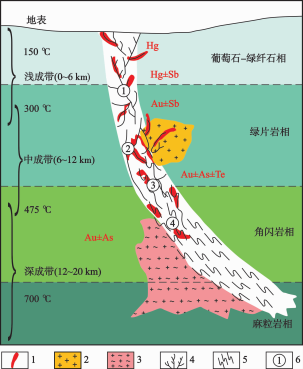
1—Orebody 2—Granite 3—Gneiss 4—Brittle structures in shear zones 5—Ductile structures in shear zones 6—Orebody morphology number
Figure 2 Crustal continuous mineralization model of orogenic gold deposits in compressional or compressional-shear tectonic settings
The ore-forming fluid is low salinity (generally less than 10%), near-neutral, rich in CO 2 reducing fluid, belonging to the NaCl-H 2O-CO2 system. Phase separation occurred during mineralization, i.e., NaCl-H 2O-CO2 fluid separated into H 2 O-NaCl and CO 2-H2 O two types of fluids, and gold precipitation occurred during this phase separation. In addition, water-rock reactions, pressure drop, and fluid mixing can also lead to gold precipitation. The ore-forming fluid mainly originates from metamorphic hydrothermal fluid, with contributions from magmatic hydrothermal fluid and atmospheric precipitation (deeply circulating groundwater). The ore-forming elements gold and mineralizing agent sulfur are most likely from sedimentary strata. The main source of gold is the enrichment of gold in sedimentary rocks (mudstones are the most favorable source areas) during metamorphic dehydration to form gold-bearing metamorphic fluids, or the extraction of gold from passing wall rocks during fluid migration and continuous enrichment, while magmatic activity contributes little to the ore-forming elements. David I. Groves et al. recently proposed that the ore-forming elements and fluids of orogenic gold deposits originate from the deep crust, where the fluid is a product of devolatilization of subducting oceanic crustal slabs, and Au and related ore-forming elements such as Ag, As, Bi, Sb, Te migrate from sedimentary pyrite in wedge-shaped oceanic sediments overlying the subducting oceanic crustal slabs into the fluid during the decomposition of pyrite into pyrrhotite, and the resulting ore-forming fluid migrates upward along lithosphere and crustal-scale fault zones.
1.2
Ore-forming conditions
Globally, from the Mesoarchean to the Cenozoic, the formation and spatiotemporal distribution of orogenic gold deposits are closely related to the supercontinent assembly process, with large orogenic gold provinces mainly appearing during accretionary orogenesis. The geodynamic setting of orogenic gold deposits is in the process of subduction or collisional orogenesis at plate (terrane) convergent margins, with accretionary amalgamation between exotic terranes or between exotic terranes and pre-existing continental margins (see Fig. 1), forming gold deposits during the compressive and transpressional deformation of the orogenic belt (see Fig. 2). David I. Groves' proposed crustal continuous mineralization model (see Fig. 2) based on Archean vein-type gold deposits in the Yilgarn Craton, Western Australia, has universal significance for understanding orogenic gold deposits. This model vertically divides gold deposits into shallow, intermediate, and deep zones based on formation depth and temperature, which are fundamentally consistent with the structural levels of mineralizing shear zones and wall rock metamorphic facies. Specifically, the shallow zone has a depth within 6km, a temperature of 150℃~300℃, and a pressure of 150~200MPa; the intermediate zone has a depth of 6~12km, a temperature of 300℃~475℃, and a pressure of 200~300 MPa; the deep zone has a depth of 12~20km, a temperature greater than 475℃, and a pressure greater than 300MPa. Although the formation depth, temperature and pressure ranges, and wall rock metamorphic facies vary widely, most orogenic gold deposits occur in the greenschist facies environment of the intermediate-shallow zone. The localization, occurrence, morphology, and size of ore bodies in orogenic gold deposits are strictly controlled by the structural deformation system during orogenesis, exhibiting multi-scale control characteristics of different levels of structures on ore belts, ore fields (mineralization clusters), and deposits. Host shear zones can form at different structural levels, meaning that gold deposits are suitable for development in different deformation regimes from ductile, brittle-ductile to brittle, and correspondingly, different forms of gold ore bodies are formed under different deformation conditions (see Fig. 2).
1.3
Prospecting significance
Orogenic gold deposits develop in subduction-accretion or collisional orogenic belts at convergent plate margins. Mineralization is associated with orogenic processes, often forming regional gold belts or provinces consisting of a series of gold deposits of considerable scale within these first-order tectonic units. Related first-order lithospheric or crustal-scale fault zones or shear zones can extend for hundreds or even thousands of kilometers along strike. Due to their great depth and wide range of mineralization, orogenic gold deposits formed in all ages are easily preserved during later geological evolution, and their erosion depth can be qualitatively inferred with great practical value based on controlling structures, alteration characteristics, and mineral and elemental assemblages. Orogenic gold deposits generally occur in second-order fault zones or third-order fault combinations, or near the structural boundaries of complex metamorphic volcanic-plutonic terranes or sedimentary terranes. These secondary structures usually intersect linear, straight first-order structural belts at a small angle, often developing localized structural styles such as undulations, branching, and intersections that are favorable for ore body emplacement. Ore bodies are mainly localized in highly permeable shear structures, fracture systems, anticlines, related thrust faults, oblique-slip duplexes, etc. These structures frequently reappear within the mining area. A characteristic feature of ore body occurrence is their emplacement in structural dilation spaces as gold-bearing carbonate-quartz veins or surrounding disseminated altered rocks. Therefore, conducting systematic ore field structural research in the exploration area to identify the nature, styles, and combinations of controlling structures, deformation sequences, etc., can provide reliable basis for delineating prospecting targets and deploying exploration engineering. Main wall rock alteration minerals include quartz, sericite, Ca-Fe-Mg carbonate minerals, pyrite, chlorite, biotite, albite, etc. Orogenic gold deposits are not highly selective regarding wall rocks; host rock types can include intermediate-basic volcanic rocks, intrusive rocks (granite-greenstone belts), banded iron formations, graywackes, turbidites, carbonaceous or carbon-bearing sedimentary rocks (shales, slates), etc. (see Fig. 3). 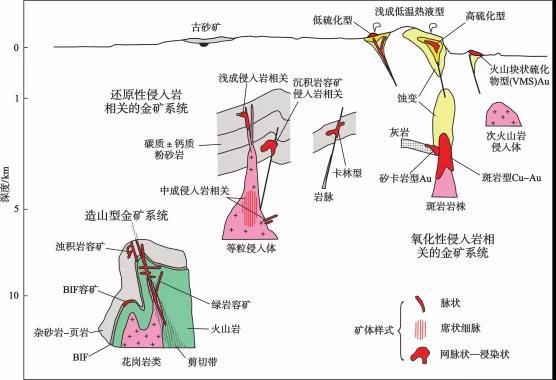
Fig. 3 Key geological elements and mineralization depth of main types of gold deposits
Deep gold-bearing fluids migrate upward along highly permeable structural belts, and related ore-forming elements can form characteristic elemental geochemical anomalies in first-order shear zones (possibly exceeding hundreds of kilometers in length). Soil and rock chip geochemical survey methods can identify anomalies of elements such as Au, Ag, As, Bi, Hg, Sb, Te, W, while at the mine and deposit scale, anomalies of Au, As, Sb, Te, W elements primarily appear. The primary halo of gold deposits is an important technical method for locating and predicting concealed gold ore bodies. Although its zonation in vertical and horizontal directions varies somewhat for different gold deposits, it can all provide effective basis for the deployment of exploration projects.
Epithermal gold deposits are mainly related to terrestrial near-surface volcanic-subvolcanic activity, occurring in terrestrial volcanic series or adjacent rocks, including basaltic andesite, andesite, dacite, and rhyolite. Epithermal gold deposits form below the paleowater table, with mineralization depths generally less than 1.5km, and individual cases reaching 2.0km (see Figure 3, Figure 4). Most mineralization temperatures are less than 300℃. 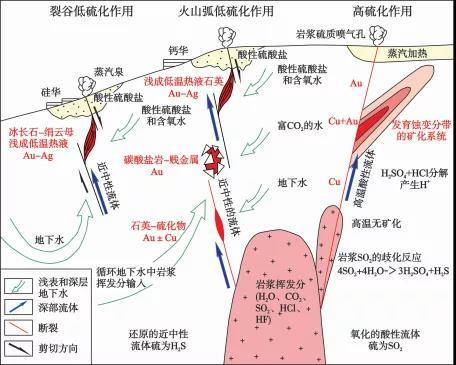
Figure 4 Occurrence Environment and Fluid Source Migration of Two Types of Epithermal Gold Deposits
Metallogenic Characteristics
According to the main mineral composition, alteration characteristics, pH, and redox state of sulfur, epithermal gold deposits have been classified into different types by various researchers: low-sulfidation, high-sulfidation, and alkaline rock types; adularia-sericite and kaolinite-alunite types; low-sulfidation and high-sulfidation types; low-sulfidation, high-sulfidation, and intermediate-sulfidation types. Among them, the intermediate-sulfidation type, as a transitional type, has limited practical significance in deposit research and mineral exploration. The currently widely accepted deposit classification is low-sulfidation and high-sulfidation. Low-sulfidation refers to ore-forming fluids where reduced sulfur species (HS - 、H 2 S) are dominant, which corresponds to the adularia-sericite type, but the latter's classification emphasizes near-neutral ore-forming fluids; high-sulfidation refers to ore-forming fluids where at least one important oxidized sulfur species (HSO 4- 、SO 4 2- 、SO 2 ) appears, which corresponds to the kaolinite-alunite type, but the latter emphasizes acidic ore-forming fluids.
Epithermal gold deposits occur in volcanic-subvolcanic geothermal systems composed of volcanic structures and surrounding structurally dilated spaces. Ore-forming elements are mainly derived from magmatic degassing. Ore-controlling structures include circumferential, arcuate, and radial faults around the volcanic crater, as well as secondary fault and fracture systems; fault and fracture systems within volcanic domes or volcanic structural depressions; cryptoexplosive breccia pipes; and high-angle fault and fracture systems in basement rocks (see Figure 4). Ore bodies are primarily hosted in volcanic rocks and contemporaneous volcaniclastic rocks, with some also occurring in underlying various basement rocks. Ore bodies are mainly vein-type, stockwork-type, and disseminated (see Figure 3, Figure 4).
2.1.1 Low-Sulfidation Gold Deposits
Low-sulfidation gold deposits occur at moderate to relatively far distances from the volcanic crater, with host rocks being volcanic rocks, and some also occurring in basement rocks. Ore bodies mainly occur as vein-type and stockwork-type, with a small amount occurring as breccia pipes and disseminated altered rocks. The style of ore bodies exhibits vertical zonation, with silica sinter (siliceous or calcareous sinter) at the surface, stockwork-type below, and then vein-type further down (see Figure 4). Ore types are predominantly quartz vein-type and stockwork-type, with a small amount of breccia-type and siliceous rock-type. Ore textures mainly include banded texture, stockwork texture, crustiform texture, bladed texture, cockade texture, comb texture, and breccia texture; ore structures mainly include colloidal structure, lattice structure, euhedral structure, and subhedral granular structure. Major ore minerals are pyrite, electrum, native gold, argentite, pyrrhotite, sphalerite, galena, arsenopyrite, with relatively low sulfide content (generally 1%~5%); major gangue minerals are quartz, chalcedony, opal, sericite, adularia, calcite, rhodochrosite, illite, chlorite, epidote. Ore-forming elements are mainly Au, Ag, Zn, Pb, with minor Cu, Sb, As, Hg, etc., w (Au)/ w (Ag) values vary significantly, generally from 0.01 to 10.00. Wall rock alteration is strong and distinctly zoned. From the ore body outwards, silicification zones, argillic zones, and propylitic zones appear successively. The silicification zone's main alteration minerals and assemblages are quartz, adularia, illite, and pyrite; the argillic zone mainly comprises illite, sericite, montmorillonite, and pyrite; the propylitic zone mainly comprises illite, chlorite, calcite, epidote, and pyrite (see Figure 5). Most ore-forming fluids are dominated by meteoric water, and may contain some magmatic volatiles (see Figure 4). Ore-forming fluid temperatures range from 100℃ to 300℃, mainly concentrated between 150℃ and 250℃; ore-forming fluid salinity ranges from 1% to 8%, typically less than 5%.

Figure 5 Mineral Assemblages and Zoning of Ore Bodies and Wall Rock Alteration in Low-Sulfidation and High-Sulfidation Gold Deposits
High-sulfidation gold deposits occur near volcanic structures, with the ore-hosting wall rock primarily being volcanic rock. Ore body types are mainly disseminated altered rock type, with minor volcanic breccia pipe type and quartz vein type. Ore types include siliceous rock type, breccia type, and quartz type. Ore textures primarily include disseminated texture, vein texture, porous texture, breccia texture, and massive texture; ore structures mainly include metasomatic structure, euhedral structure and hypidiomorphic granular structure. Ore minerals include pyrite, enargite, chalcopyrite, tennantite, covellite, argentite, native gold, tellurides, with relatively high sulfide content (10%~80%); gangue minerals include quartz, alunite, barite, kaolinite, pyrophyllite. Metallogenic elements are mainly Cu, Au, Ag, As, with minor Pb, Hg, Sb, Te, etc., w (Au)/ w (Ag) value is generally less than 1. Wall rock alteration is well developed, showing clear zonation. Generally, from the ore body outwards, silicification zone, advanced argillic zone, argillic zone, and propylitic zone appear in sequence. The silicification zone's main alteration minerals and assemblage are quartz and alunite; the advanced argillic zone's main alteration minerals and assemblage are kaolinite, pyrophyllite, sericite, illite; the argillic zone's main alteration minerals and assemblage are montmorillonite, illite, chlorite; the propylitic zone's main alteration minerals and assemblage are chlorite, epidote, calcite (see Figure 5). Vertically, the top consists of steam-heated lacustrine sediments, generally containing minerals such as native sulfur or pyrite, alunite, and kaolinite; opal and kaolinite develop near the paleo-erosion surface, and chalcedony veins can form near the paleo-water table; downwards, strongly leached porous quartz-alunite-kaolinite, dickite-sericite-pyrophyllite-anhydrite, quartz-pyrophyllite-sericite, and other alteration mineral assemblages appear sequentially. The ore-forming fluid is mainly magmatic water, with a certain mixture of atmospheric precipitation (see Figure 4); the ore-forming fluid temperature is 140℃~300℃, mainly concentrated at 200℃~300℃; the ore-forming fluid salinity is 1%~25%, mostly concentrated at 4%~8%.
2.2
Ore-forming conditions
Epithermal gold deposits primarily form in near-surface environments of calc-alkaline to alkaline magmatic arcs, including oceanic island arcs and continental arcs (see Figure 1), with the main geodynamic setting being subduction at convergent plate boundaries. Additionally, this type of gold deposit also occurs in intra-arc, back-arc extensional zones, and post-collisional rift environments (see Figure 4). Mao Jingwen et al. pointed out that Mesozoic epithermal gold deposits in eastern China formed in Jurassic-Cretaceous continental margin volcanic-faulted basins or uplifted areas along fault-developed magmatic-volcanic rock belts, with their geodynamic background being intracontinental extension, tectonic regime transformation, and large-scale lithospheric thinning. Intrusive rocks associated with epithermal mineralization are oxidative, consistent with porphyry copper-gold deposits, while intrusion-related gold deposits and Carlin-type gold deposits are associated with reductive intrusive rocks (see Figure 4). Globally, epithermal gold deposits are mainly concentrated in 3 giant metallogenic domains: the Circum-Pacific Metallogenic Domain, the Tethyan Metallogenic Domain, and the Laurasian Metallogenic Domain. Mineralization occurs during volcanic-subvolcanic activity. Generally, the mineralization temperature is less than 300℃, the mineralization depth is less than 2km, and the mineralization pressure is less than 50MPa. Ore-forming fluid activity requires abundant fault and fracture systems and high-porosity wall rocks to provide sufficient dilation space.
2.3
Prospecting significance
Epithermal gold deposits have shallow mineralization depths and are prone to exhumation or erosion during later geological processes. Additionally, some high-sulfidation gold deposits form in the shallow parts of active volcanic structures, and later reactivated volcanic eruptions may destroy these deposits or early geothermal systems. Currently preserved epithermal gold deposits mainly formed in the Meso-Cenozoic, with very few forming in the Late Paleozoic. Therefore, terrestrial intermediate-acidic and alkali-rich volcanic-subvolcanic activity areas (belts) since the Cretaceous are the main target areas for epithermal gold deposits. Epithermal gold deposits, along with underlying porphyry-type gold deposits and transitional sulfide-quartz vein type gold-silver deposits, constitute a complete metallogenic system. Thus, the porphyry-epithermal copper-gold-silver polymetallic deposits in the Dexing area of Jiangxi province form a genetically related metallogenic system. The presence of epithermal gold deposits may indicate the development of porphyry-type gold deposits at depth, and conversely, the presence of porphyry-type gold deposits may indicate the development of epithermal gold deposits at their upper or periphery, meaning that under certain geological conditions, they can serve as reciprocal exploration indicators. Generally, high-sulfidation gold deposits are about 1km from deep-seated concealed porphyry bodies, while low-sulfidation gold deposits are farther away. Volcanic structures and their surrounding fault and fracture systems are favorable locations for ore bodies to occur. Ore bodies often occur in clusters and belts, sometimes covering an area of up to 200km 2 . Characteristic alteration minerals and assemblages, alteration zonation, and associated fault and fracture structural systems are the most important and effective prospecting indicators. At the same time, the degree of later erosion and the modification of ore body and altered rock distribution by tectonics must be fully considered. Therefore, large-scale structural-alteration facies mapping is an effective geological prospecting method.
Airborne and ground gravity surveys show good resolution for volcanic-subvolcanic areas (belts). Low-resistivity anomalies caused by mineralization or argillic alteration, high-resistivity anomalies caused by mineralization or silicification, and ore-controlling faults can all be revealed using high-density electrical methods. Aeromagnetic surveys can reflect low magnetic anomalies formed by hydrothermal alteration. Radiometric surveys in volcanic rock areas can obtain enhanced radioactivity anomalies mainly caused by potassic alteration.
Hydrogeochemical measurements of water system sediments, soils, and rocks are very effective in obtaining information on epithermal gold mineralization and alteration. Geochemical anomalies of ore-forming elements such as Au, As, Sb, and Hg, and rock-forming elements such as K, Na, Si, and Mg indicate potential low-temperature hydrothermal mineralization and alteration zones. Using portable shortwave infrared spectroscopy for alteration mapping of epithermal gold deposits can quickly and effectively identify alteration traces, mineral assemblages and zoning, especially in identifying clay minerals. It can also reveal subtle changes in the chemical composition of white mica (illite-sericite) and chlorite, enhancing the significance of alteration zoning and mineralization location, thus guiding sample collection during the reconnaissance stage and reducing drilling workload. In arid and semi-arid regions, remote sensing hyperspectral information can effectively identify alteration minerals and mineral assemblages for regional and mine-scale remote sensing alteration mapping. By acquiring many very narrow spectral continuous image data in multiple bands such as visible light, near-infrared, shortwave infrared, and thermal infrared, it is easy to distinguish advanced argillic zones, argillic zones, and silicified zones related to the mineralization of high-sulfidation gold deposits. Combining hyperspectral information with field geological information can map illite and illite-montmorillonite alteration in low-sulfidation gold deposits.
Carlin-type gold deposits are so named because they were discovered in the Carlin area of Nevada, western United States, in 1961. The earliest discovered gold was mainly dispersed in carbonate rock formations in microscopic-submicroscopic forms, so it is also called micro-disseminated gold deposit. Later exploration and research work has shown that this type of gold deposit also develops in siliceous rocks, siltstones, and tuff. Therefore, Carlin-type gold deposits can be briefly summarized as low-to-medium temperature hydrothermal gold deposits occurring in carbonate rocks, fine clastic rocks, and siliceous rocks that have not undergone regional metamorphism, with low base metal content and fine disseminated gold distribution. Since their discovery, more than 100 independent Carlin-type gold deposits have been successively discovered in the northern "basin and range province" of western United States, with a cumulative gold resource of more than 5000t, gold grade of 1~25g/t, mainly concentrated in 1~10g/t, which has become the third largest gold producing area in the world. These gold deposits are distributed in two nearly parallel north-northwest-trending gold belts with a spacing of about 60km. The northeastern gold belt is called the Carlin Trend, with a length of about 200km and gold resources of about 3000t; the southeastern gold belt is called the Battle Mountain-Eureka Trend, with a length of about 300km and gold resources of about 2000t.
3.1
Metallogenic Characteristics
The Carlin-type gold deposits in the Carlin area of Nevada, USA, are hosted in Cambrian-Triassic clastic rocks and carbonate rock formations, mainly concentrated in Ordovician, Silurian, and Devonian bedded or thin-bedded carbonate rocks and fine clastic rock strata. Among them, dolomitic limestone and dolomitic siltstone have the best mineralization, followed by argillaceous dolomite, calcareous shale, and calcareous siltstone. After these rocks undergo decarbonation, the porosity and permeability can be effectively improved, which is conducive to the circulation of ore-forming fluids. If they contain carbonaceous matter, it is more conducive to the adsorption and enrichment of gold. There are three main types of orebody occurrences: firstly, they occur near the intersection (cutting) of the above-mentioned favorable mineralized rock units and high-angle normal faults, forming irregular stratiform, tabular, and lenticular metasomatic altered orebodies with indistinct boundaries with the surrounding rocks; secondly, they occur in high-angle faults or secondary faults, and faults related to folds, forming vein-like and banded orebodies with distinct boundaries from the surrounding rocks, with higher ore grades; thirdly, they occur at the intersection of faults, with strong deformation and fragmentation of ore-bearing rocks, forming stockwork orebodies. The ore textures are mainly disseminated texture, veinlet-disseminated texture, and breccia texture; the ore structures are mainly colloform structure and metasomatic structure (such as siliceous replacement of carbonate rocks). The main ore minerals are pyrite, siderite, realgar, orpiment, stibnite, arsenopyrite, cinnabar, thallium arsenosulfide, and a small amount of sulfides of copper, lead, zinc, tungsten, and molybdenum. The total content of sulfides is generally 1%~5%. Most of the native gold is micron-level and submicron-level, mostly submicroscopic invisible gold. The gangue minerals are mainly chalcedony, illite, kaolinite, fluorite, calcite, and barite. The main ore-forming element assemblage is Au-As-Hg-Sb-Tl-Ag, w (Au)/ w (Ag) values vary greatly, but are generally much greater than 1. Wall-rock alteration is well developed, mainly including decarbonation, argillization, sulfidization (arsenopyrite, arsenopyrite, realgar, orpiment, and stibnite), silicification, and baritization. The alteration characteristics of different Carlin-type gold deposits are different. Overall, the alteration zoning from the orebody to the wall rock (see Figure 6) is shown as follows: ① decarbonation, quartz + dickite/kaolinite + pyrite ± gold; ② strong decarbonation, dolomite + quartz + illite ± kaolinite + pyrite ± gold; ③ weak to moderate decarbonation (dolomite halo), dolomite ± calcite + quartz + illite ± kaolinite + pyrite ± gold; ④ fresh silty limestone, calcite + dolomite + illite + quartz + K-feldspar + pyrite. The widespread decarbonation is characterized by partial or complete leaching of calcite and dolomite in the wall rock, increasing the porosity of the carbonate rocks and providing the necessary space for the migration and precipitation of ore-forming fluids.
3.2
Ore-forming conditions
The Carlin-type gold deposits in Nevada, USA, occur in the shallow crust of a back-arc extensional zone at a convergent plate margin (see Figure 1). The mineralization depth is generally less than 4km, and the mineralization age is 36~42Ma. This period is the stage of transition from convergence to extension of the Cordillera foreland thrust belt. Widespread extension began, and a north-south metamorphic core complex belt across western United States developed. The calc-alkaline magmatism migrated towards the continent. These tectonic thermal events accompanied the formation of Carlin-type gold deposits, epithermal gold deposits, and porphyry gold deposit systems. In the above tectonic setting, high-angle main faults and secondary faults and fracture systems are the dominant factors controlling the activity of ore-forming fluids. In addition, some orebodies occur in gentle anticlines, pre-mineralization collapse breccia bodies, or different lithological contact zones. The control or influence of lithology on mineralization mainly lies in providing a place for the activity of ore-forming fluids, such as decarbonated limestone, debris flow sediments, phase transition zones, high porosity or high permeability strata, etc. The temperature of the ore-forming fluid is 180℃~240℃, and the salinity is low (2%~3%). 
1—Devonian Popovich Formation 2—Silurian-Devonian Roberts Mountains Formation 3—Ordovician Vinini Formation 4—Calcite dissolution (illite) 5—Advanced calcite and dolomite dissolution (illite + sericite) 6—Siliceous argillaceous zone with residual dolomite (illite + sericite) 7—Jasper (diaspore/kaolinite) 8—Calcite veins 9—Sericite or diaspore/kaolinite altered igneous veins 10—Breccia zone 11—High-angle normal fault
Figure 6 Alteration characteristics of Carlin-type gold deposits
3.3
Prospecting significance
Carlin-type gold deposits are characterized by clustered and zonal occurrences. Therefore, in exploration practice, it is necessary to consider the evaluation of regional mineralization potential on a large scale based on tectonic background, metallogenic geological conditions, and ore-controlling factors, guiding the strategic deployment of exploration work. Widely developed joints and fissures often appear in groups, filled with various hydrothermal veins of different periods, such as quartz veins, barite veins, kaolinite veins, pyrite veins, carbonate veins, and realgar veins, which themselves constitute a type of ore and are also important indicators of the possible development of main ore bodies in the fractures at depth. Similar to epithermal low-temperature hydrothermal gold deposits, characteristic alteration minerals and assemblages, alteration zoning, and related fault and fracture systems are the most important and effective geological prospecting indicators. At the same time, it is necessary to fully consider the later erosion and oxidation of ore bodies and altered rocks, so large-scale structural-alteration lithofacies mapping is also an effective geological method for finding Carlin-type gold deposits.
Soil and rock chip geochemical anomalies of Au, As, Hg, Sb, and Ag elements are important information for finding Carlin-type gold deposits. Hyperspectral remote sensing information can effectively identify alteration minerals and mineral assemblages. Portable shortwave infrared spectroscopy can quickly and effectively identify alteration mineral assemblages and zoning. In the exploration practice of the entire Carlin Town area, it has been proved that the combination of geological mapping and the obtained geological model understanding with soil and rock geochemical measurements has played a prominent role and is a very effective exploration technique for finding Carlin-type gold deposits. In later exploration work, based on geological and geochemical work, controlled-source audio magnetotelluric method, induced polarization method, and ground magnetic survey can reveal deep ore-controlling structures and identify lithology, which is important for finding concealed ore bodies.
4
Gold deposits are important targets for ore-forming theoretical research and exploration. A large number of research and exploration practices have shown that continuously improving geological understanding or models of ore deposits is an important prerequisite and basis for exploration work. Characteristic metallogenic features, metallogenic conditions, and ore-controlling factors are the key geological basis for identifying and confirming the types of gold deposits. Based on this, according to the characteristics of different types of gold deposits, selecting suitable geological, geophysical, geochemical, or remote sensing techniques or combinations can greatly improve exploration efficiency. In addition, in the exploration work of new exploration areas, based on the information of surface geophysical and geochemical surveys and remote sensing anomalies, combined with the regional tectonic background, it is also possible to reasonably infer and select potential gold deposit types. Three main types of gold deposits, orogenic, epithermal low-temperature hydrothermal, and Carlin-type, are widely developed in China, often forming large-scale metallogenic belts, metallogenic provinces, or large ore clusters. Continuously improving the comprehensive understanding of regional metallogenic systems and metallogenic laws, and learning from each other's experience and achievements in exploration theories and methods with the same or similar tectonic background and the same type of deposits, can greatly promote the realization of large-scale exploration breakthroughs.