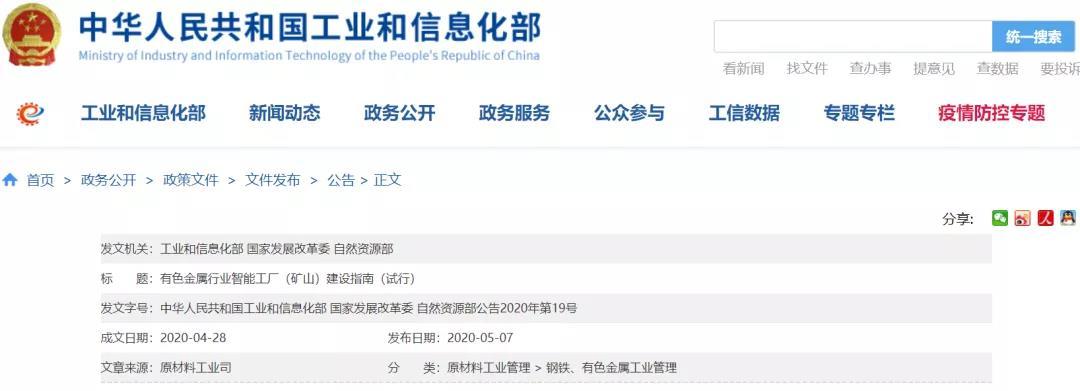
Yesterday (May 7), The Ministry of Industry and Information Technology, the National Development and Reform Commission, and the Ministry of Natural Resources recently jointly issued the 'Guidance on the Construction of Smart Factories (Mines) in the Nonferrous Metals Industry (Trial)' (hereinafter referred to as the 'Guidance', click 'Read Original' at the end of the article to view the full text). The relevant content of the 'Guidance' is interpreted as follows:
I. Why was the 'Guidance' issued?
The nonferrous metals industry is a typical process industry, characterized by diverse types, complex raw material sources, long and complex processes, and harsh working conditions. Overall, the smart manufacturing level in the nonferrous metals industry is relatively backward, making it difficult to meet the needs of high-quality development. Among them, mining equipment mainly relies on manual operation, with high labor intensity and high safety risks; smelting equipment has many types and environmental/safety sensitive sources, and the automation control level of enterprises varies, especially small enterprises with backward process equipment and heavy reliance on manual operations, facing severe environmental governance and safety production situations; some processing enterprises record production and operation data manually on paper, lack sufficient online monitoring methods, have low quality control capabilities, and lack flexibility in production organization.
Under the new situation of the vigorous development of a new round of scientific and technological revolution and increasing resource and environmental constraints, enterprises have generally recognized the importance of smart manufacturing and are accelerating the promotion of digitalization and networking. Some enterprises have made breakthroughs in intelligent applications in local areas such as unmanned cranes, intelligent equipment diagnosis, and automatic copper plate peeling. However, most enterprises face problems such as unclear construction goals and paths, unsystematic construction content, insufficiently highlighted construction priorities, and difficulties in project promotion. Many are "groping for stones to cross the river," lacking systemic awareness, suffering from severe information silos, and easily falling into misconceptions such as "emphasizing local transformation over overall optimization," "emphasizing business system construction over data value mining," and "emphasizing construction over operation and maintenance."
To further promote the integrated innovation and integrated application of new generation information and communication technologies such as 5G, industrial internet, and artificial intelligence in the nonferrous metals industry, and to provide top-level design and comprehensive guidance for enterprises to carry out smart manufacturing at the operational level, we have researched and compiled the construction guidelines for smart mines, smart smelting factories, and smart processing factories in the nonferrous metals industry, clarifying requirements in terms of construction goals, construction paths, construction content, and basic support.
II. How was the 'Guidance' formulated? What are the overall considerations?
In April 2019, we initiated the compilation of the nonferrous smart manufacturing guidance. Core enterprises such as Aluminum Corporation of China (Chalco), Jiangxi Copper, and China Gold, research institutes such as Beijing General Research Institute of Mining and Metallurgy (BGRIMM), ENFI, and China Nonferrous Metal Industry's Foreign Engineering and Construction Co., Ltd. (NFC), and smart manufacturing suppliers such as Baoxin and Huawei formed three special drafting groups for mining, smelting, and processing. They successively conducted preliminary research on smart manufacturing at 21 nonferrous enterprises in Fujian, Guangdong, Chongqing, and other regions, fully drawing on advanced experience from domestic and international sources and other industries to form the initial draft of the 'Guidance'. After public consultation and soliciting opinions from 6 departments including the National Development and Reform Commission, the Ministry of Science and Technology, the Ministry of Natural Resources, the Ministry of Ecology and Environment, the Ministry of Emergency Management, and the State Administration for Market Regulation, further revisions and improvements were made. The 'Guidance' was then formed through deliberation and approval at an academician and expert review meeting. The overall considerations for the 'Guidance' are as follows:
First, fully align with national policies, adhering to a combination of foresight and practical implementation. The 'Guidance' is guided by "Internet + Advanced Manufacturing" guidelines and smart manufacturing engineering implementation guidelines, based on the national smart manufacturing standard system, and aims to support the green, safe, and efficient development of nonferrous enterprises. The overall design adopts a cloud, edge, and terminal architecture based on an industrial internet platform. Combined with the characteristics of nonferrous enterprises, it particularly emphasizes the digital transformation of infrastructure, the application of advanced industrial software, and collaborative innovation based on industrial big data. In terms of specific implementation, the 'Guidance' highlights both foresight and practical implementation. It fully considers the smart manufacturing construction foundation of enterprises, clarifies the construction paths for old plant renovation and new plant construction, and specifies the construction priorities for basic and leading enterprises, focusing on "strengthening foundations and addressing weaknesses." It also strives to promote the application of technologies such as 5G, artificial intelligence, and virtual reality in remote collaboration, intelligent batching, short-circuit identification in electrolytic cells, and smelting virtual simulation, aiming to "consolidate strengths and seek breakthroughs."
Second, based on industry characteristics and development needs, clarify the key areas for enterprise smart manufacturing construction. Based on the industry characteristics of mining, smelting, and processing and the current status of smart manufacturing, the 'Guidance' adheres to a problem-oriented approach, focusing on the intrinsic safety and resource-intensive needs of mines, the clean, environmentally friendly, high-quality, and low-consumption needs of smelting, and the stable quality and flexible production needs of processing. It focuses on core business aspects such as R&D, equipment, production, operation, and supply chain collaboration, addressing prominent problems commonly faced by enterprises, such as unstable production line equipment foundations, low levels of safety and environmental control, disconnect between informatization and management, and insufficient motivation for applying advanced technologies. The 'Guidance' clarifies the specific application stages and key construction areas for new technologies by setting up special columns for smart equipment, 5G application scenarios, industrial APPs, etc., guiding qualified enterprises to pilot first.
Third, promote changes in enterprise management models and build continuously optimized guarantee mechanisms. To ensure the smooth promotion and construction effectiveness of enterprise smart manufacturing projects, the 'Guidance' not only clarifies enterprises' primary responsibility and guides them in top-level design and determining construction priorities, but also, based on the successful experience of advanced enterprises in smart manufacturing project construction, emphasizes overall planning and a problem-oriented approach. It specifies basic support requirements in terms of capital investment, organizational planning, talent teams, operation and maintenance, information resources, and standard systems, guiding enterprises to address issues such as rampant 'copy-paste' practices, insufficient leadership attention, insufficient continuous capital investment, and scarcity of compound talents, thereby providing fundamental elemental guarantees for enterprises to implement the 'Guidance'.
III. What are the respective focuses of the construction goals for smart mines, smart smelting factories, and smart processing factories?
The smart manufacturing construction goal for nonferrous enterprises is to achieve digital aggregation, networked sharing, and platform-based collaboration of resource elements such as production, equipment, energy, and logistics, to build nonferrous metal smart factories (mines) that are self-perceiving, self-learning, self-deciding, self-executing, and self-adapting. Among them, nonferrous metal mines are characterized by dynamic changes in mining areas, high accident risk rates, large waste emissions, and urgent need for improved resource recovery rates. Especially in some mines located in high-altitude, cold regions, the demand for replacing human labor with machines is urgent. The 'Guidance' proposes to build an intrinsically safe, resource-intensive, green, and efficient nonferrous metal smart mine that integrates digital management of resources, smart production control for "ore flow," fully automated and semi-automated production processes, integrated intrinsic safety management, and big data-based intelligent decision-making; nonferrous metal smelting is characterized by complex production conditions, harsh working environments, extensive energy management, and difficulties in process modeling and multi-process collaboration. The 'Guidance' proposes to build a clean, environmentally friendly, high-quality, low-consumption, safe, and efficient nonferrous metal smart smelting factory that integrates a comprehensive integrated information control platform, a real-time collaborative optimized smart production system, and refined energy efficiency management; nonferrous metal processing is characterized by a wide variety of product types and specifications, small order batches, long production processes, high product precision requirements, and frequent logistics scheduling, requiring quick response to market and customer demands. The 'Guidance' proposes to build a stable-quality, collaboratively efficient, and quickly responsive nonferrous metal smart processing factory that integrates flexible production organization, full lifecycle management of product quality, and supply chain collaborative optimized operations.
IV. What are the construction paths for smart manufacturing in existing enterprises and new enterprises?
Addressing issues such as varying production scales, diverse equipment types, and uneven automation levels among non-ferrous metal enterprises, the Guidelines advocate for a "tailor-made, problem-oriented, and results-focused" approach to ensure guidance aligns with enterprise realities and enhances precision. Enterprises should develop comprehensive plans, implement them in phases, define construction priorities, and systematically advance intelligent manufacturing based on their development strategies and actual production and operation conditions. For existing mines and factories, implementation plans should consider factors such as urgency of enterprise needs, infrastructure conditions, and financial capacity. Based on standardized processes, data, and operating procedures, equipment should be upgraded for digitalization and intelligence, gradually building a comprehensive integrated production control platform to achieve full process tracking and traceability. Simultaneously, relevant data should be continuously accumulated, enabling innovative applications through an industrial big data platform. Specifically for small and medium-sized processing enterprises, given their smaller production scales, lower automation levels, and extensive production management, the Guidelines emphasize strengthening information infrastructure and cybersecurity, gradually implementing equipment digitalization. For new mines and factories, high-standard, high-starting-point, and high-level intelligent manufacturing implementation plans should be developed based on overall mine and factory planning, considering advanced technologies, equipment, information technology, and manufacturing technologies. Intelligent equipment requirements should be met during the infrastructure construction phase, followed by the construction of relevant production control systems in the later stages. After reaching production targets, an industrial big data analysis platform should be built based on accumulated data. The Guidelines also suggest that enterprises can concurrently advance the above work based on supporting conditions during actual construction.
Why does the Guideline adopt a "cloud-edge-end" architecture based on the Industrial Internet?
Traditional IT architectures are insufficient to support large-scale knowledge reuse and functional expansion, hindering the development of intelligence. An Industrial Internet-based technical architecture, however, can support digital models and microservices containing extensive industrial knowledge, significantly improving the reuse of industrial knowledge. To emphasize both forward-looking and practical aspects, the Guidelines encourage enterprises to adopt a "cloud-edge-end" architecture based on the Industrial Internet. Existing information systems based on traditional IT architectures can serve as data sources for the platform, continuing to leverage their remaining value. The gradual cloud deployment of traditional information systems will address the migration of enterprise systems to the Industrial Internet and the connection between individual enterprises and industry platforms. The Guidelines also encourage enterprises to prioritize migrating hardware, software, and data to the cloud, gradually integrating core business systems into the cloud and enabling cross-enterprise cloud collaboration. Considering enterprise technical foundations, financial strength, and development needs, and to leverage the support, guidance, and demonstration of large enterprises, the Guidelines encourage qualified large enterprises to build Industrial Internet platforms and encourage small and medium-sized enterprises to use them.
What are the main construction contents of intelligent mines, intelligent smelting factories, and intelligent processing factories? What are the construction priorities, and how are they considered?
Based on the construction concept of "remediation of Industry 2.0, popularization of Industry 3.0, and demonstration of Industry 4.0" for intelligent manufacturing in the non-ferrous metals industry, and referencing the intelligent manufacturing system architecture in the "National Intelligent Manufacturing Standard System Construction Guide," the Guidelines clarify that the digital transformation of infrastructure achieves the convergence and interconnection of resource elements; the construction of intelligent production systems achieves information fusion and sharing; and intelligent service applications based on service-oriented manufacturing promote the development of new business models. To stimulate enterprise vitality, the Guidelines also define requirements for the construction of collaborative innovation platforms based on industrial big data, supporting enterprises in continuously innovating data applications. In terms of specific construction content, enterprises should focus on the following aspects:
1. Digital transformation and construction of infrastructure. Infrastructure includes the application of new instruments and meters, automated transformation of production lines, application of complete sets of intelligent equipment, network deployment, and cybersecurity construction. For non-ferrous mines, where tasks such as drilling, charging, support, loading, and transportation involve high labor intensity and harsh working conditions (high temperatures, dust, noise, etc.), the Intelligent Mine Guidelines encourage the use of intelligent drilling rigs, intelligent anchor bolting rigs, intelligent loaders, intelligent trucks, and intelligent charging vehicles with autonomous driving and operation capabilities to reduce labor intensity and improve intrinsic safety. For non-ferrous smelting, which involves complex processes with high temperatures, dust, strong magnetic fields, strong corrosion, and difficulties in real-time detection of key process parameters and performance indicators, the Intelligent Smelting Factory Guidelines encourage infrastructure digital transformation and the application of intelligent instruments and equipment in labor-intensive and high-risk tasks such as smelting, melt unblocking, and electrolytic casting to achieve clean production and safe operation. For non-ferrous processing, where processes such as casting, rolling, extrusion, and drawing require high precision control and high production speeds, the Intelligent Processing Factory Guidelines encourage the use of automatic control and intelligent sensing technologies to digitally transform existing rolling mills, extruders, heat treatment furnaces, and other equipment, or to configure intelligent equipment, improving industrial networks and cybersecurity to achieve stable and precise quality control.
2. Construction of intelligent production systems driven by business needs. For non-ferrous mines, which face challenges such as large volumes of complex and dynamic geological resource information data, two-dimensional manual mining design, mining equipment primarily relying on manual operation, low automation of filling systems, and difficulties in coordinating multiple ore dressing processes, the Intelligent Mine Guidelines encourage enterprises to establish intelligent production systems with functions such as process optimization, dynamic scheduling, and energy consumption management through the digitalization of mining resources, intelligent control of mining and dressing processes, integrated management of intrinsic safety, and mine virtual simulation. This will build a highly integrated, intelligent, and flat mining production and operation management model. For non-ferrous smelting, which faces challenges such as difficulties in coordinating key processes such as pyrometallurgical smelting, waste heat boilers, and flue gas dust removal, inability to predict and self-regulate, large fluctuations in extensive production adjustments, lagging process control response, reliance on manual experience, and serious information silos, the Intelligent Smelting Factory Guidelines encourage enterprises to establish advanced industrial control software based on mechanism models, empirical models, and simulation models to optimize production operations and equipment operating parameters. The Guidelines encourage the construction of systems for data acquisition and centralized monitoring, production organization and scheduling, production management and execution, and enterprise management and business decision-making to achieve real-time monitoring, dynamic scheduling, and collaborative optimization. For non-ferrous processing, which faces challenges such as diverse product specifications, small order batches, long production process routes, multiple parallel process paths, and frequent logistics scheduling, the Intelligent Processing Factory Guidelines encourage enterprises to establish a production operation control center for data-driven, visualized real-time monitoring and unified scheduling and centralized management of orders, plans, processes, quality, equipment, energy, safety, and personnel within the management area. The Guidelines encourage the establishment of production planning and scheduling systems based on supply chains, data models, and intelligent optimization algorithms to achieve large-scale personalized customization.
3. Construction of intelligent service applications based on service-oriented manufacturing. Addressing the urgent need for remote maintenance of key equipment such as drilling rigs and loaders in non-ferrous mines, low efficiency and lack of transparency in the procurement and warehousing logistics of bulk raw materials in non-ferrous smelting enterprises, and the dispersed downstream customers, fast response speed, and diverse personalized needs of non-ferrous processing enterprises, the Intelligent Mine, Smelting Factory, and Processing Factory Guidelines guide enterprises to connect information channels between consumption and production, supply and manufacturing, and products and services, integrating information resources and reducing overall supply chain costs, with a focus on ensuring continuous production. Enterprises are encouraged to develop service-oriented manufacturing, innovate service models, and prioritize cloud deployment of industrial APPs such as remote equipment maintenance and energy contract management, providing services to other enterprises in the industry and effectively extending the enterprise's industrial chain.
Fourthly, it is about building a collaborative innovation platform based on industrial big data. Addressing issues such as insufficient data value mining in non-ferrous metal enterprises, process technology and enterprise management limited by manual experience, and insufficient knowledge sharing, the guidelines for intelligent mines, smelting plants, and processing plants encourage enterprises to build a collaborative innovation system based on industrial big data, stimulate enterprise vitality and endogenous motivation, promote the knowledge precipitation and comprehensive sharing of enterprise process technology and management experience, and apply innovations to business scenarios such as equipment operation optimization, process parameter optimization, quality management optimization, production management optimization, and business decision optimization in the enterprise's production manufacturing process and business management activities.
VII. How should enterprises promote the highly-focused work on information security, production safety, and environmental protection during the intelligent manufacturing process?
Regarding information security, The Guidelines propose that, in accordance with the requirements of relevant documents such as the Cybersecurity Law and the Guiding Opinions on Strengthening Industrial Internet Security, unified planning and design should be implemented, an information security management system should be established, attention should be paid to industrial control network security, a technical support system for active defense and comprehensive protection should be formed, and the ability to perceive, monitor, warn, respond to emergencies, and trace the source of information security should be improved.
Regarding production safety, The Guidelines propose that the health, safety, and environmental protection work at the production site should be standardized, and an active safety management and protection system characterized by comprehensive assessment, closed-loop management, real-time linkage, and intelligent early warning should be built through the application of intelligent equipment and the construction of an integrated safety and emergency control center, comprehensively improving personnel behavioral safety, operating environment safety, and equipment operation safety.
Regarding environmental protection, The Guidelines propose that intelligent monitoring methods and positioning technology should be used to monitor in real time the wastewater and waste gas discharge points, the generation and disposal links of solid waste, and the equipment data and environmental information in key environmentally protected areas, so as to achieve timely analysis, effective early warning, and source control of potential sudden environmental events and major hazard sources.
VIII. How do the Guidelines guide enterprises in the application of 5G, artificial intelligence, and big data and other new generation information and communication technologies?
The Guidelines clearly point out that the application of cutting-edge technologies such as the Internet, big data, artificial intelligence, 5G, edge computing, and virtual reality in non-ferrous metal enterprises should be promoted, and specific application scenarios are given, such as using the advantages of the large bandwidth of the 5G network and ADAS (Advanced Driver-Assistance Systems) technology to carry out the construction of unmanned mining systems; using artificial intelligence and machine learning technologies to establish virtual simulation models of key equipment and production processes, and guiding actual production through the construction of artificial intelligence batching systems; using big data technology to comprehensively analyze customer distribution, industry, type, source, qualifications, and risks, deeply mining customer needs, and providing support for enterprise business decision-making.
IX. How should enterprises implement the Guidelines?
First, enterprises should change their understanding and establish a sense of responsibility of "taking the initiative". Intelligent manufacturing serves the enterprise strategy. To achieve the expected results, enterprises need to combine their own regional characteristics, product positioning, process equipment, management model, and the foundation of two-integration to develop tailor-made solutions. In addition, intelligent manufacturing projects are different from traditional "turnkey" projects. They involve the optimization of enterprise business processes and improvements in management models. The evolution of enterprise strategies also requires iterative updates of related systems. This requires enterprises not to over-rely on external solution providers, but to take the initiative and participate deeply.
Second, enterprises should make good plans and "leverage" to proceed in an orderly manner. Intelligent manufacturing is a complex system project that requires advanced concepts and a professional team. Enterprises exploring on their own are easily misled. It is recommended that enterprises, in accordance with the Guidelines, clarify their goals and business needs. For enterprises with insufficient experience in intelligent manufacturing construction, they should entrust external intelligent manufacturing suppliers to carry out intelligent manufacturing basic diagnosis, top-level design, and project implementation work, and organize internal employees to ensure the implementation plan and project quality and progress from the perspectives of economy, applicability, and advancement. At the same time, rely on the project to conduct intelligent manufacturing publicity and training for enterprise employees and cultivate maintenance teams.
Third, enterprises should take good guarantee measures and establish a normalized operation mechanism. Intelligent manufacturing is closely related to the vision, business model, management system, and culture of the enterprise. To ensure that the expected results are achieved, enterprises should, in accordance with the basic support requirements in the Guidelines, improve the guarantee measures in terms of organization, funds, and personnel, strengthen organizational leadership, set up specialized management and technical maintenance positions, formulate special fund usage management systems, increase the introduction of talents and the cultivation of compound talents, and carry out standardized work on information resource management to achieve normalized operation.
X. How to promote the implementation of the Guidelines?
First, strengthen guidance and services. Conduct research on enterprise intelligent manufacturing, mobilize enterprises to conduct self-assessment of intelligent manufacturing according to the requirements of the Guidelines, identify gaps, clarify needs, comprehensively understand the current situation of enterprise intelligent manufacturing, the difficulties in implementing the Guidelines, and the needs for intelligent manufacturing system solutions, and provide more accurate guidance services for enterprises.
Second, establish industry alliances. Together with the non-ferrous metal association, etc., we will study the establishment of a non-ferrous metal industry intelligent manufacturing alliance, and focus on the work in terms of results transformation, pilot demonstration, standard formulation, and technological innovation, promote efficient docking between enterprises, experts, and suppliers, and simultaneously carry out the collection of excellent cases, suppliers, and solutions to form a non-ferrous metal industry intelligent manufacturing basic information database.
Third, increase support. Encourage relevant local government departments to use various policy measures to support enterprises in carrying out intelligent construction and transformation in accordance with the requirements of the Guidelines, and form a policy synergy for implementing the Guidelines.