
New technology! This grinding method can save 12,394,000 yuan! Seeing is learning!
Jan 23,2021
Due to scarce resources, large-scale industrial production and a significant increase in processing capacity have become a trend. Large-scale autogenous and semi-autogenous grinding and beneficiation methods are more economically efficient than traditional three-stage crushing beneficiation methods, and therefore have developed significantly.
Taking a 4 million t/a underground iron mine in a certain region as an example, compared with the traditional grinding process, in terms of production cost, the total equipment weight is reduced by 614t, saving 25% in construction investment, saving 25% in annual electricity consumption, saving 3.994 million yuan in annual electricity consumption, saving 2 million yuan in annual crushing liner plates, and increasing the annual grinding liner plate consumption by 6.6 million yuan, saving 13 million yuan in annual steel consumption. The total annual savings amount to 12.394 million yuan, excluding reduced job welfare costs, construction investment savings, depreciation, and corresponding reductions in job wages and benefits.
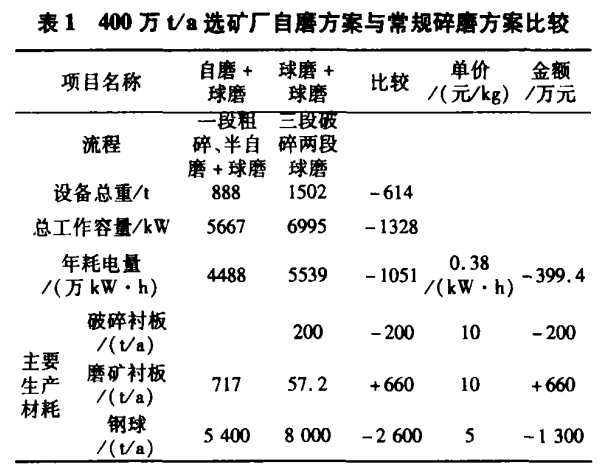
It is evident that the large-scale development of autogenous grinding technology has considerable economic and social benefits.
Moreover, the cost of semi-autogenous grinding can be further compressed, and the key factor is the grinding medium "steel balls". Most production enterprises hope that the mill can operate stably during the grinding process, and The sign of stable operation is a stable steel ball filling rate. In this way, under the condition of stable ore supply, Stable ore processing capacity and higher qualified particle size generation can be maintained.
Currently, the filling rate of steel balls in most mills can only be determined after the mill stops operating, and Professor Wang Baoqi, technical consultant of Gangnuo New Materials Co., Ltd. proposed a new theory, which is Based on the dynamic prediction law of the steel ball filling rate in the mill, the wear resistance of the grinding balls is effectively evaluated. This theory can be used in the process of mill operation, It can accurately predict the change trend of the mill filling rate, So as to dynamically adjust the ball adding system or adjust the ore supply, providing an important means for grinding workers to judge the performance of grinding balls.
The following is a detailed introduction:
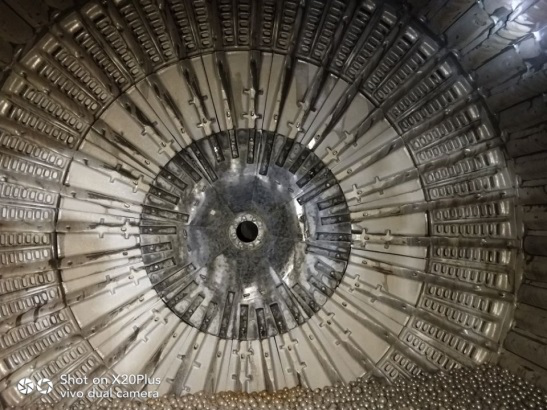
Measuring the steel ball filling rate in a semi-autogenous mill
1. Mill filling rate under the simultaneous addition system of two types of grinding balls with the same specification but different properties
The grinding balls added to the semi-autogenous mill will be discharged from the grate plate holes after the service cycle. The diameter of the grinding balls initially added is , and the diameter of the grinding balls discharged from the grate plate holes is . Due to the different properties of the two types of grinding balls added to the mill simultaneously, the wear rate exponents of the two types of grinding balls are different, which are and respectively. The service cycles of the two types of grinding balls are respectively

During the operation of the mill, in order to maintain the stable operation of the mill, according to the operation law of the mill and the axial pressure, the ore supply is kept constant, and the daily amount of balls added is adjusted, which is the operating principle advocated by various grinding workers. Assuming that the processing capacity of the mill remains basically unchanged, the number of grinding balls added on the day are and respectively, and after days of operation, the weights of the first and second types of grinding balls in the mill are and respectively,
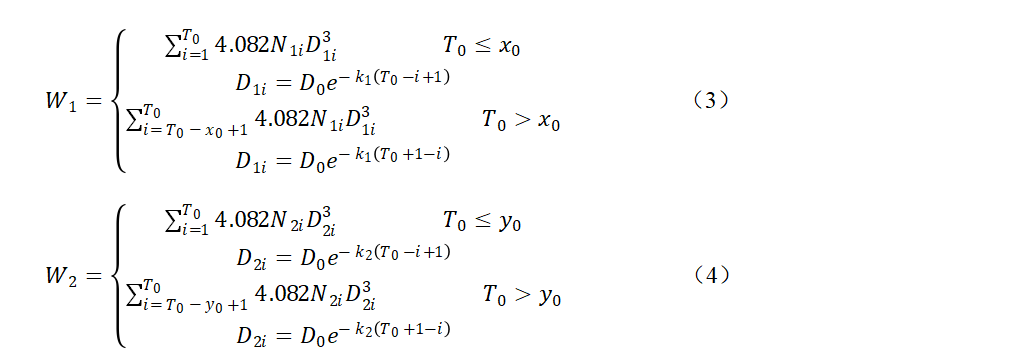
The total weight of grinding balls in the mill should be the sum of the weights of the two types of grinding balls. That is

Thus, the corresponding filling rate can be obtained. Through the diameter and corresponding number of the two types of grinding balls in the mill,
The ball charge particle size characteristics in the mill can be known. At the same time, according to the daily ore processing capacity corresponding to a certain filling rate, the wear index can be obtained.
2. Filling rate under the system of adding two different specifications of grinding balls to the mill simultaneously
In the semi-autogenous grinding process, sometimes due to changes in operating conditions, such as changes in ore particle size and properties, and liner wear, it is necessary to add two different specifications of steel balls. The diameters of the grinding balls initially added are and respectively. If the properties of the two types of grinding balls are different, the wear rate exponents of the two types of grinding balls are and respectively. The service cycles of the two types of grinding balls are respectively
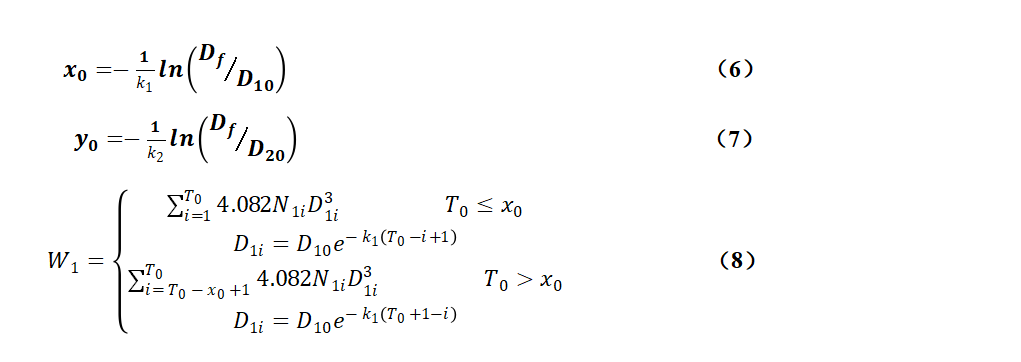
The same as above, the sum of the two is the total weight of grinding balls in the mill. The ball charge particle size characteristics in the mill can be obtained from the diameter and quantity of the two types of grinding balls, which can be easily calculated by computer.
3. Calculation of filling rate when the performance of the same type of grinding ball is uneven
The diameter of the steel balls used in semi-autogenous mills is large. From some technical perspectives, this large-specification grinding ball product often only has a certain depth of quenching layer, that is, during the service life of the grinding ball, the wear rate exponent is different, which makes the wear law of the grinding ball change in stages. In the quenching layer range (depth is , its wear rate exponent is , and after the quenching layer is worn, its wear rate exponent is ), at this time, the weight of the grinding balls in the mill can be described as
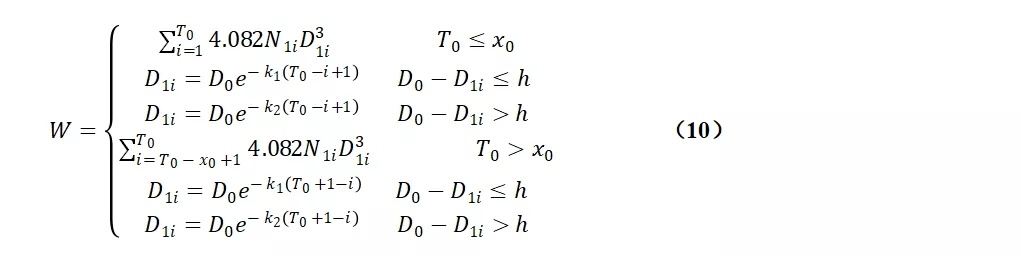
Under various steel ball replenishment systems and steel ball performance change conditions, according to the given calculation formula, the weight of steel balls in the mill at a certain moment can be calculated, and then the filling rate of steel balls can be obtained.
The situation of Gangnuo company's products in semi-autogenous mills
4. Case analysis
The semi-autogenous mill specification is , processing iron ore, with an effective volume of 475, using low-hardness 120 steel balls, the wear is 0.95 kg/t ore, the steel ball size discharged from the grate plate hole of the autogenous mill is 80 mm, the daily ore processing capacity is 22200 tons, and the mill filling rate is 12%. In order to reduce wear, high-hardness multi-element alloy forged steel grinding balls were used, reducing wear to 0.63 kg/t ore. If the two are mixed and added, with a ratio of 7:3 for high-hardness grinding balls to low-hardness grinding balls, maintaining a filling rate of 12%, calculate the wear under this condition.
According to reference [1], it can be solved that, for ordinary grinding balls

For high-hardness grinding balls,

According to formulas (3) and (4), to ensure a filling rate of 12%, it is calculated that 4.702 tons of ordinary Φ120 balls need to be added daily; 10.971 tons of high-hardness Φ120 balls need to be added. With a daily ore processing capacity of 22200 tons at a 12% filling rate, the wear is 0.706 kg/t ore.
Grinding ball gradation in the mill. Through calculation, the total number of ordinary balls in the mill is 15318, and those above 100 mm account for 10/23, with a quantity of 6660. The total number of high-hardness balls in the mill is 52881, and those above 100 mm account for 15/34, with a quantity of 23330. The proportion of balls above 100 mm in the mill is 29990/68199 = 44%.
The calculation of the filling rate and wear under other ball adding conditions can be completed according to the method provided in this article.
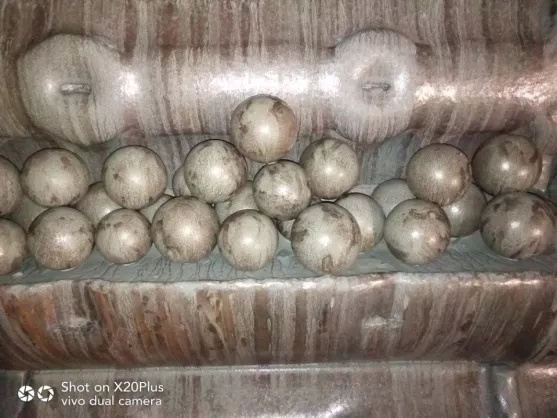
Gangnuo company's products on the liner lifting bar of the semi-autogenous mill
Conclusion
This article provides a method for calculating the filling rate and wear of a semi-autogenous mill under different ball addition conditions. Using the method given in this article, combined with a large amount of data from the long-term operation of the mill, the wear resistance of the grinding balls can be evaluated, and dynamic adjustments can be made during the mill operation to achieve the optimal operating state, providing useful insights.